Mesa’s tap water runs between 12 and 22 grains per gallon, more than double the national average of roughly 7 GPG, and well into the “very hard” classification.
That single fact changes everything about how a custom shower should be designed here.
The wrong grout, the wrong stone, the wrong drain placement, and that gorgeous new shower starts looking dingy within six months.
The right choices, installed correctly, can add $10,000–$15,000 to your home’s perceived value and make your bathroom one of the selling points buyers remember.
At Castle Floors in Mesa, our design team works with East Valley homeowners every week on exactly this kind of project.
What you’ll discover in this article:
Why Does Mesa’s Environment Change What Tile and Grout Hold Up?
Which Custom Shower Design Is Right for a Mesa Home?
1. Walk-In Curbless Shower (Zero-Entry)
2. Frameless Glass Shower Enclosure
3. Natural Stone Shower Walls (With the Right Sealing Protocol)
7. Accessible Shower with Bench and Grab Bars (Aging-in-Place Design)
What Does a Custom Shower Installation Cost in Mesa in 2026?
How Do You Maintain a Custom Shower in Mesa’s Hard Water?
How Do You Choose the Right Custom Shower Contractor in Mesa?
Frequently Asked Questions: Custom Showers in Mesa
How much does a custom shower installation cost in Mesa in 2026?
Does Mesa’s hard water really affect shower tile and grout that much?
How long does a custom shower remodel take from design consultation to completion?
How do I know when my shower grout needs to be replaced vs. just resealed?
Is a custom tile shower better than a prefabricated shower unit for resale in Mesa?
Ready to talk through your space before reading further?
Schedule a Design Consult and Febe and the Castle Interiors team will walk through your bathroom, pull materials, and give you a clear picture of what’s possible in your budget.
Why Does Mesa’s Environment Change What Tile and Grout Hold Up?
Most national shower remodeling content ignores local conditions. That’s a real problem in Mesa, where three environmental factors directly affect which materials last and which ones fail.
Water hardness.
Mesa water averages 12.8 grains per gallon (GPG), classified as “very hard.” Some zones climb closer to 22 GPG depending on which water source serves your block. For context, most U.S. cities consider anything above 7 GPG to be hard. Mesa runs nearly twice that at its average, higher still in neighborhoods on local wells. At those mineral levels, calcium and magnesium deposits build up on grout lines, glass surfaces, and natural stone faster than most homeowners expect.
Marble and limestone are particularly vulnerable.
Hard water causes mineral deposit buildup and surface staining on calcite-based stones, and acidic cleaners (the kind many Mesa homeowners reach for to cut through that same mineral scale) cause etching and dulling on the same surfaces.
It’s a two-front problem.
Porcelain tile and engineered quartz are lower-maintenance options precisely because they don’t react to mineral deposits or acidic cleaners the way natural stone does
Temperature Swings
Mesa sees summer highs above 110°F and mild winters that still dip into the 30s. That 70-plus degree seasonal range puts stress on tile adhesion, especially in showers on exterior walls. Think of the substrate as a piece of metal expanding and contracting every season: if the tiles above it aren’t given room to move, they crack. A crack-isolation membrane like Schluter DITRA addresses thermal movement; a waterproofing membrane like KERDI addresses moisture. They solve different problems. The best practice for a Mesa shower is both, or a combination product like Schluter KERDI-DS. Installers who skip these layers are cutting corners that show up as cracked grout 18 months later.
Low humidity with monsoon spikes
Annual relative humidity in the Valley averages 30–35%, but monsoon season (July through September) pushes that up suddenly. Standard sanded grout can absorb moisture during humid spikes and dry out again during the dry season, a cycle that eventually leads to cracking and mold. Epoxy grout and large-format tile with minimal grout joints are the smarter long-term play for Mesa showers.
The Las Sendas and Superstition Country neighborhoods near the east side of Mesa have particularly hard water because they’re served by wells pulling from mineral-rich desert aquifers. Homeowners in those areas should treat shower grout as a maintenance item from day one, not an afterthought.
Pro-Tip from the Castle Interiors Design Team
[quote] In the 85205 and 85207 ZIP codes, we see more grout staining and mineral buildup than almost anywhere else in our service area. Mesa’s water regularly tests above 12 GPG, hard enough to leave visible calcium deposits on glass and unglazed grout within weeks. We recommend epoxy grout on all shower walls and floors in Mesa, and a penetrating sealer on any natural stone surface at installation, with a re-seal every 12–18 months. It’s not extra work. It’s the only way to keep the investment looking sharp.
Which Custom Shower Design Is Right for a Mesa Home?
Here’s what actually works for Mesa resale value and everyday livability. Not every design fits every home. The right choice depends on your square footage, your existing plumbing stack, and who is most likely to buy your house when you sell.
1. Walk-In Curbless Shower (Zero-Entry)
Curbless shower installation in Mesa has become the single most-requested design in the past three years, and it’s not just a trend. Buyers in every demographic respond to the clean sightline and accessibility of a zero-entry shower. Removing the curb also eliminates the number one grout failure point in traditional showers.
For Mesa homes built in the 1970s and 1980s, especially ranch-style layouts in the 85205 ZIP code, curbless conversions often require subfloor work to accommodate proper drainage slope. In Mesa, where slab-on-grade construction is the norm, this can mean cutting the concrete slab to reposition the drain. It’s a legitimate structural step that adds to the project budget and timeline. Worth it, but not a surprise you want on demo day.
Best for: Ranch-style and open-plan homes in 85205, 85207, and Las Sendas where a clean modern sightline matters most. Best tile choice: Large-format porcelain (24×24 or 24×48) with rectified edges. Fewer grout lines mean less mineral buildup and easier cleaning in Mesa’s hard-water environment. Installed cost range: $8,000–$14,000 for a standard porcelain build with linear drain and waterproofing membrane.
2. Frameless Glass Shower Enclosure
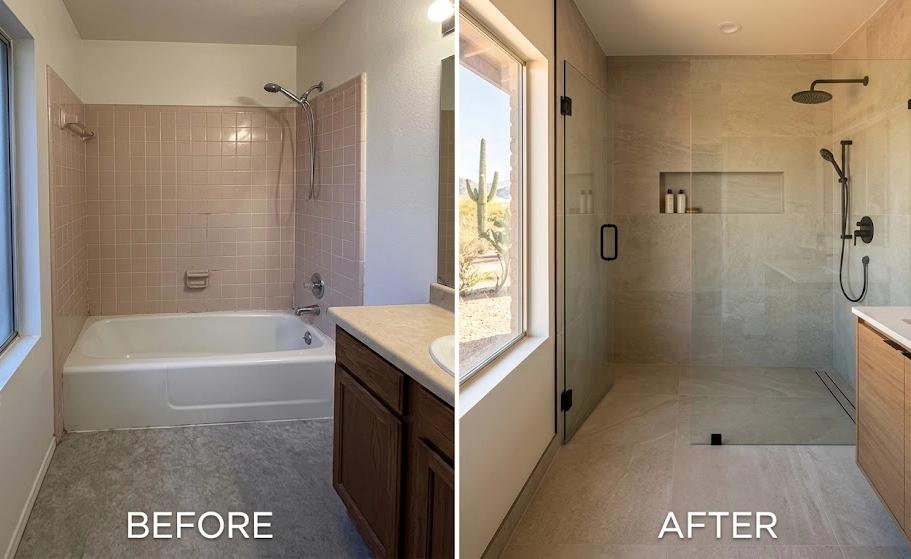
Frameless glass shower doors are a visual multiplier. In a smaller master bathroom, a frameless glass enclosure makes the room feel significantly larger than a framed door or curtain. For Mesa resale, this is one of the highest perceived-value upgrades per square foot of bathroom space.
The installation detail that separates a lasting frameless enclosure from one that leaks: wall tile needs to be set with exactly the right tolerance, and the waterproofing membrane must be tight at every seam. Walls that are slightly out of plane will show immediately. A common pairing in Las Sendas and the Citrus neighborhood: large-format porcelain shower walls, frameless glass, and a brushed nickel or matte black linear drain.
Browse our tile and stone collection to find the right porcelain for this pairing.
Best for: Any master bath where visual impact and resale photography matter, particularly homes in the $400K–$700K range where buyer expectations are high.
Best tile choice: Large-format rectified porcelain in neutral tones. The frameless glass does the design work, so let the tile anchor rather than compete. Installed cost range: $2,500–$5,500 as a standalone add-on to an existing or new custom shower build.
3. Natural Stone Shower Walls (With the Right Sealing Protocol)
Natural stone showers photograph beautifully and attract buyers who want something that feels custom and permanent. In Mesa, they require more maintenance than porcelain, but they’re worth considering for high-end primary bath remodels where the design investment matters.
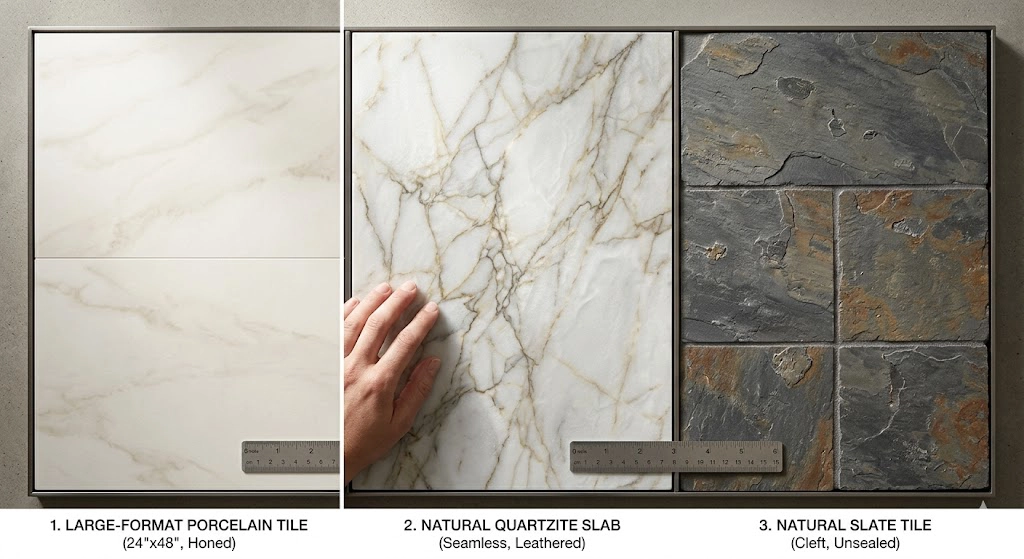
Quartzite (not to be confused with quartz) is denser and more water-resistant than marble or travertine. Slate is naturally slip-resistant and handles moisture well. Travertine is softer and more porous. Filled travertine, where the natural voids are grouted closed before sealing, holds up significantly better in wet areas than unfilled travertine. Unfilled travertine in a Mesa shower is a high-maintenance choice that requires more frequent attention.
Marble is the riskiest choice. The calcium carbonate in marble etches when exposed to acidic cleaners, which are exactly the products Mesa homeowners reach for to cut mineral scale. Hard water causes mineral deposit buildup and surface staining on top of that. In Mesa, marble faces both threats at once. If a client insists on marble, we specify a penetrating sealer, honed finish, and epoxy grout, and we have an honest conversation about long-term expectations. See our full backsplash and wall tile options for the stone and porcelain selections we carry for shower wall applications.
Best for: High-end primary baths in Las Sendas, the Citrus neighborhood, and East Mesa new construction where the design budget supports premium material and ongoing maintenance. Best tile choice: Quartzite or filled travertine for durability; slate for natural slip resistance on shower floors. Avoid polished marble unless the homeowner fully understands the maintenance commitment. Installed cost range: $10,000–$20,000 for a custom natural stone shower surround, plus annual sealing cost.
4. Tub-to-Shower Conversion
Removing an unused soaker tub and building a custom walk-in shower in its place is the most common project in Mesa’s resale-prep pipeline. The logic is simple: most adults over 40 take showers, not baths. A generous walk-in shower with storage niches and a rainfall showerhead tests better with buyers than a large tub they’ll never use.
One note for Mesa homeowners: keep at least one bathtub somewhere in the house. Most real estate professionals in the East Valley will tell you that a home with zero bathtubs can narrow your buyer pool. The most practical approach is to convert the primary bath tub while keeping the guest bath tub intact. You get the upgrade where it matters most without limiting resale appeal.
Ready to see what this looks like in your space? Schedule a Design Consult ($250) and Febe will walk your bathroom with you before a single tile is ordered.
Best for: Primary baths where the soaker tub hasn’t been used in years. Especially strong ROI for homes in the 85205, 85203, and 85215 ZIPs.
Best tile choice: Large-format porcelain for the surround; mosaic tile on the floor for grip. Keep the palette neutral to maximize buyer appeal. Installed cost range: $5,000–$15,000 depending on tile selection, glass enclosure, drain type, and plumbing changes required.
5. Spa-Like Steam Shower
Steam showers represent the top tier of custom shower installation in Mesa, and the local climate makes them unexpectedly popular. When it’s 108°F outside in July, a steam shower feels genuinely indulgent. Steam is also gentle on dry skin, a real quality-of-life benefit in the desert.
A properly built steam shower requires a fully enclosed tile space (ceiling included), a dedicated steam generator, and a tight-fitting glass door with minimal gap tolerance to contain steam during use. Waterproofing is non-negotiable. We use Schluter KERDI systems on every steam build because the moisture demands are far higher than a standard shower.
If a full steam shower isn’t in the budget, a ceiling-mounted rainfall showerhead paired with wall-mounted body jets and a thermostatic valve delivers a meaningful spa experience at a fraction of the cost. Thermostatic valves are worth the added expense: they hold water temperature precisely and prevent the swings that come with older pressure-balancing valves. A rainfall/body jet package typically adds $500–$3,000 depending on whether ceiling plumbing relocation is required.
Best for: Larger primary suites in East Mesa new construction, Las Sendas, and the 85215 ZIP where square footage supports an enclosed ceiling build.
Best tile choice: Large-format porcelain or engineered quartz on walls and ceiling. Both handle steam humidity without the sealing burden of natural stone. Installed cost range: $12,000–$25,000+ for a full custom steam shower; $500–$3,000 to add a rainfall/body jet package to any existing build.
6. Wet Room Design
A wet room, where the entire bathroom floor and lower walls are waterproofed and tiled with no separate shower enclosure, is one of the most dramatic upgrades in Mesa’s higher-end primary bath market. With no threshold, no frame, and no enclosure wall to contain the space visually, a wet room reads as intentional luxury architecture rather than a renovation.
In Las Sendas and the newer builds along Power Road, wet rooms fit naturally into open-plan primary suites with larger square footage. In older homes, they require more preparation: the entire floor must be waterproofed to TCNA standards, drainage must be precisely planned, and ventilation must handle the increased moisture load. Done correctly, a wet room is essentially impossible to replicate with a prefab unit, which is exactly why it photographs so well and registers so strongly with serious buyers.
Best for: Larger primary suites with sufficient square footage for an open, unenclosed layout. Strong resale play for homes at the top of the East Valley market.
Best tile choice: Large-format non-slip porcelain throughout. Consistent tile from floor to wall reads as architectural intention, not an afterthought. Installed cost range: $15,000–$30,000 depending on square footage, tile selection, and the extent of plumbing and waterproofing work required.
7. Accessible Shower with Bench and Grab Bars (Aging-in-Place Design)
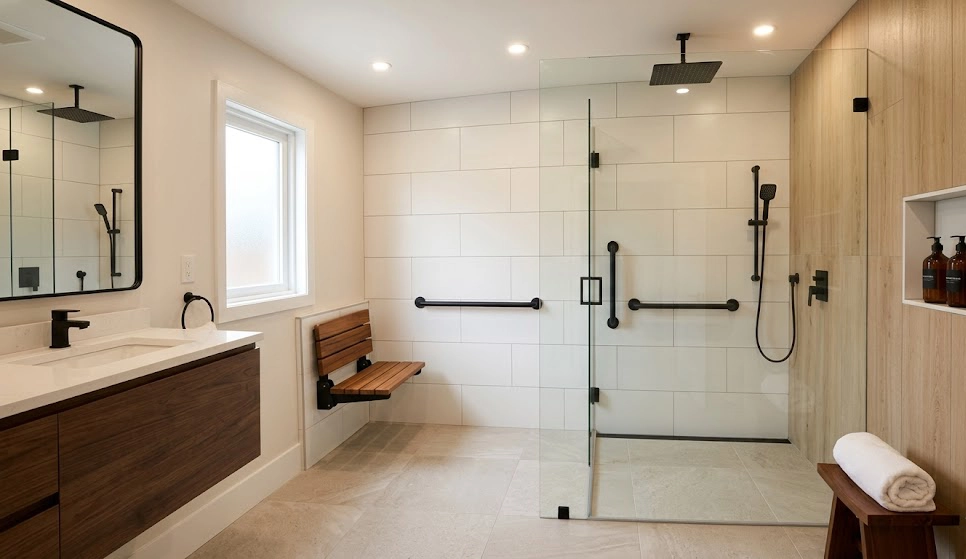
Mesa’s aging population is significant. The 85205 ZIP code has a median age well above the state average, and demand for aging-in-place shower modifications has grown steadily. Roll-in shower installation, grab bar placement, fold-down benches, and curbless entry are not just accessibility features. They’re selling points for the largest and fastest-growing buyer demographic in the East Valley.
Done with quality tile and design intent, an accessible shower doesn’t look clinical. It looks modern. A curbless entry with a teak fold-down bench, matte black grab bars, and large-format non-slip porcelain reads as intentional design, not a medical accommodation.
Residential accessible shower design is guided by aging-in-place and universal design principles, not ADA standards, which apply to commercial and public facilities rather than private homes. The NKBA has published detailed residential accessibility guidelines that go well beyond code minimum requirements and produce far better outcomes for homeowners. This is the framework we use at Castle Floors.
Best for: Primary baths in homes where the occupants are 55+ or where the buyer pool skews toward active-adult demographics, especially the 85205, 85206, and Leisure World-adjacent ZIPs.
Best tile choice: Large-format non-slip porcelain on floors (coefficient of friction matters; ask us about COF ratings); smooth, easy-clean porcelain on walls. Installed cost range: $7,000–$14,000 for a full aging-in-place shower build with grab bars, bench, curbless entry, and slip-resistant tile.
From Febe, Castle Interiors Designer: “The projects I’m proudest of are the ones where the homeowner came in thinking they just needed new tile and left with a shower that genuinely changed how their bathroom feels and functions. In my experience, the difference between a shower that lasts 5 years and one that lasts 30 comes down to what happens before the first tile goes up: the substrate, the membrane, the drain slope. That’s where we spend most of our design conversation.”
“Castle Floors is the kind of company you want to work with! We had them out to our home to give some estimates on redoing our bathroom. Here are some reasons my husband and I decided on Castle Floors: they are honest and knowledgeable, they ask exactly the right questions about how you use the space, and they don’t just show you what looks pretty, they show you what will hold up.” – Marissa C., East Mesa, Bathroom Remodel Estimate
Schedule a Design Consult to start that conversation with us directly.
What Does a Custom Shower Installation Cost in Mesa in 2026?
Pricing in Mesa varies based on tile selection, glass enclosure type, waterproofing system, drain choice, and whether plumbing relocation is needed.
What specifically drives price variation in Mesa is substrate condition. Older homes in the 85205 and 85203 areas often have original tile over original drywall with no waterproofing membrane behind it. Removing that tile, installing cement backer board, applying a waterproofing membrane, and leveling the substrate can add $1,500–$4,000 before a single new tile goes up. Skipping this step is how leaks and mold problems start.
Want a quote built around your actual space? Visit Our Showroom This Week, no pressure, no obligation. Febe and the team can walk you through tile selections in person and help you visualize the finished space with our Roomvo flooring and tile visualizer.
How Do You Maintain a Custom Shower in Mesa’s Hard Water?
Mesa’s hard water is your shower’s biggest long-term adversary. Understanding what to do and when keeps your investment looking sharp for years.
Sealing natural stone. Any natural stone surface in a Mesa shower needs a penetrating sealer applied at installation. Plan to re-seal travertine and limestone every 12 months given water hardness above 12 GPG. Quartzite and slate can go 18–24 months between sealings. Marble requires the same annual attention as travertine, and because it’s also vulnerable to acidic cleaners, the maintenance conversation starts at installation, not when problems appear. You’ll know it’s time to re-seal when water no longer beads on the surface. The Natural Stone Institute recommends an impregnating sealer rather than a topical coating for wet areas, as topical sealers can peel and trap moisture underneath.
Grout maintenance. Epoxy grout is the top choice for Mesa showers because it doesn’t absorb moisture, resists staining, and doesn’t react to minerals in hard water. It does require an experienced installer. Mixing ratios and working time are less forgiving than cement grout, and epoxy is harder to repair if damaged. Standard cement grout needs to be sealed at installation and re-sealed annually. If you see grout lines darkening or softening, address it before water infiltrates the wall system behind the tile.
Weekly cleaning. A squeegee after every shower is the single most effective maintenance habit in a hard-water market. It takes 30 seconds and prevents the calcium buildup that clouds glass and stains grout. Use a pH-neutral cleaner on tile and stone. Acidic cleaners, vinegar included, will etch natural stone and break down grout sealer over time. This is the most common maintenance mistake we see in Mesa homes with marble or travertine.
Linear drain maintenance. If you’ve chosen a linear drain, plan to clean the drain insert weekly. It pulls out in seconds. In Mesa’s hard-water environment, mineral scale accumulates in the channel faster than in softer-water markets. A non-acidic mineral deposit remover applied monthly keeps the channel clear without damaging the drain finish.
When to call a professional. DIY grout resealing is reasonable. DIY grout removal and replacement is workable for small areas. Anything involving the waterproofing membrane behind the tile, including soft spots, soft wall boards, or moisture bubbling under tile, requires a professional assessment. The Ceramic Tile Education Foundation (CTEF) is an excellent resource for understanding what a proper installation should look like and what warning signs to watch for.
From Febe, Castle Interiors Designer: “One of the first things I ask every client before we pull tile samples is: what cleaners do you currently use on your shower? In Mesa, I can almost predict the material failures I’ll see on a site visit just from that answer. The right tile and the wrong cleaner will give you a damaged surface inside two years. The right tile and the right cleaner, that’s a 20-year shower.”
“We had Castle Floors out for a flooring project and as it turned out, we had several cracks in our foundation which needed to be ground down to make the floor level, as well as an area that needed to be filled with self-leveling concrete. Johnny explained, in detail, everything he was doing and why. At least we know the job was done correctly, plus the floors are guaranteed for life.” Corey H., Mesa, Tile and Flooring Installation
How Do You Choose the Right Custom Shower Contractor in Mesa?
Not every tile contractor in the East Valley is equipped to handle a full custom shower installation. Here’s what to look for before signing anything.
Ask about substrate assessment first. Before any contractor quotes you a price, they should look at what’s behind your current shower wall. If they quote without checking for existing water damage, unlevel surfaces, or the presence of a waterproofing membrane, that quote will change on demo day. A trustworthy contractor builds substrate assessment into their initial site visit.
Ask specifically about waterproofing. The waterproofing system is the most important element of a custom shower, and also the most commonly skipped in low-bid jobs. Ask which membrane system they use. Industry standards from the Tile Council of North America (TCNA) specify membrane requirements for wet area installations. Schluter KERDI and similar sheet membrane systems are the professional standard. If a contractor mentions thinset as their “waterproofing,” keep looking.
Look for licensed, bonded, and insured. In Arizona, tile and flooring contractors should hold an active ROC (Registrar of Contractors) license. Castle Floors is licensed, bonded, and insured under ROC #135975. Verify any contractor you’re considering at the Arizona ROC website before work begins.
Red flags in a quote. Vague warranty language, no mention of backer board or membrane, no site visit before quoting, and no discussion of drain slope or waterproofing continuity at wall-floor transitions. These are signs that the bid is based on best-case assumptions, not an honest assessment of your specific job.
At Castle Floors, every custom shower project begins with an in-person design consultation. Febe reviews your bathroom layout, existing plumbing, and the condition of your current substrate before we discuss tile or glass. We don’t quote from photos. That’s the difference between a project that goes smoothly and one that turns into a series of “while we were in there” conversations. You can learn more about Castle Interiors design services and our full approach to bathroom tile and shower design.
Castle Floors has served Mesa and the East Valley since 1976. The team that works your project is the same team that’s been building relationships in this market for nearly 50 years. When you call back in six months with a question about grout sealer, we answer.
Schedule a Design Consult ($250) and Febe will review your bathroom in person and give you a clear project picture before anything is ordered.
Frequently Asked Questions: Custom Showers in Mesa
How much does a custom shower installation cost in Mesa in 2026?
Most custom shower projects in Mesa run between $6,000 and $20,000 installed, depending on tile selection, glass enclosure type, waterproofing system, and whether plumbing relocation is required. A mid-range walk-in shower with large-format porcelain tile, frameless glass, and a linear drain typically lands between $10,000 and $16,000 in the current Mesa market. Steam showers, wet rooms, and natural stone builds can exceed $20,000 for larger spaces. The most reliable way to get a firm number is a site visit where the contractor assesses your existing substrate, not a photo-based quote.
Does Mesa’s hard water really affect shower tile and grout that much?
Yes, more than most homeowners realize. Mesa water hardness averages around 12.8 GPG, nearly double the national average, classified as “very hard.” At those mineral levels, calcium deposits form on unglazed grout lines and glass surfaces faster than in softer-water markets. Natural stone surfaces etch over time when exposed to the acidic cleaners many homeowners use to combat that same mineral buildup. We recommend epoxy grout for all Mesa showers, a penetrating sealer on any natural stone at installation, and a squeegee habit after every use.
How long does a custom shower remodel take from design consultation to completion?
For a standard tub-to-shower conversion or custom walk-in shower, plan on 5–14 business days of active construction once materials arrive. The full timeline from initial design consultation to completed installation typically runs 3–6 weeks, depending on material lead times and project complexity. Steam showers and projects involving plumbing relocation take longer. At Castle Floors, most clients have their tile ordered within two weeks of the initial design consult.
How do I know when my shower grout needs to be replaced vs. just resealed?
Reseal if the grout surface is stained but still solid and intact. Replace grout if you see soft spots, crumbling, cracks that run the full depth of the grout joint, or discoloration that suggests moisture has gotten behind the tile. In Mesa homes, failing grout near the shower floor and lower wall courses is usually the first sign of a waterproofing problem. Don’t cover failing grout with new tile. Address the substrate before re-tiling.
Is a custom tile shower better than a prefabricated shower unit for resale in Mesa?
For resale value, yes. Prefabricated acrylic or fiberglass shower units read as builder-grade in most East Valley buyer pools, particularly in homes priced above $450,000. A custom tile shower with frameless glass reads as a premium upgrade and photographs significantly better in MLS listings. A well-installed custom tile shower with proper waterproofing will also outlast a prefabricated unit by decades.
Your Next Step
The right shower design for your Mesa home is not the same as the right design for a home in Chicago, Portland, or Houston.
Water hardness, temperature swings, monsoon humidity, and housing stock all shape what works here. Castle Floors has been helping East Valley homeowners navigate those specifics since 1976.
Our in-house designer Febe leads every Castle Interiors consultation, walking you through tile selection, layout planning, material tradeoffs, and the installation details that determine whether a shower remodel lasts 20 years or 20 months.
Stop by our showroom at 4500 E Main St., Suite 3, Mesa, AZ 85205, open Monday through Friday 8 AM to 5 PM, Saturday 8 AM to 4 PM. We also offer 0% interest financing for qualifying projects. Call us at (480) 396-6956 or Schedule a Design Consult ($250) to get started today.