Two contractors. Two different recommendations. One says LVP, the other says laminate, and now you’re trying to figure out which one actually knows what they’re talking about.
We see this situation at our showroom on East Main St. constantly. Both products look like wood. Both float over a subfloor without glue. Both cost significantly less than real hardwood. The difference is how they perform in a Mesa home over time, and that answer is specific to this climate in ways that national guides won’t cover. Call us at (480) 396-6956 or book a free in-home estimate at castlefloorsaz.com/free-estimate and we’ll cut through the noise.
Why the LVP vs. Laminate Debate Is Different in Arizona
Most LVP vs. laminate articles online are written for temperate climates. The checklist: waterproofing, hardness, price, appearance. In Mesa, that checklist is incomplete.
Mesa’s summers push indoor floor temperatures near glass doors past 120 degrees Fahrenheit. Humidity drops below 15% RH in summer, per NOAA data for Maricopa County. And nearly every home in the East Valley, from Las Sendas to Queen Creek, sits on a concrete slab rather than a wood subfloor. Each of those three factors changes how LVP and laminate behave, in ways the product box won’t tell you. Our guide to flooring in Arizona’s heat at castlefloorsaz.com/blog/best-flooring-arizona-heat-mesa covers the broader climate breakdown if you want the full picture.
Castle Floors Flooring Team: “In Mesa, the question we ask before recommending either product is: which direction does the room face, and how much sun does it get? A north-facing bedroom is a very different installation than a west-facing living room with a sliding glass door. The same floor can be the right answer in one room and the wrong answer in the other. That’s why we always do a site visit before we quote.”
How LVP and Laminate Actually Differ
LVP and laminate are both engineered floating floors with a photographic wood-look layer on top. After that, the similarity ends.
LVP’s core is made of PVC plastic. Completely waterproof, highly flexible, and dimensionally stable across wide temperature swings. Laminate’s core is high-density fiberboard, or HDF, a wood-based material that responds to moisture and temperature the way wood does.
Want to see how both look in your actual room before deciding? The Roomvo visualizer at castlefloorsaz.com/flooring-visualizer lets you upload a photo of your space and see either product in it before you commit.
Here’s how that material difference plays out in Mesa specifically:
Heat Performance
LVP expands and contracts with temperature but returns to its original dimension reliably. Quality products are rated to 140 degrees Fahrenheit or higher. Laminate’s HDF core expands at a different rate than its surface layer when temperatures spike, which causes edge lifting and surface telegraphing over time in high-heat rooms.
Humidity
LVP is unaffected by Mesa’s sub-15% summer humidity. Laminate’s HDF core shrinks in very dry conditions. At the humidity levels Mesa sees in summer, that shrinkage can cause click joints to separate, not just cosmetic gapping but a structural loosening of the lock system.
Slab Foundation
Both float over concrete and both benefit from Mesa’s non-flexing slabs. LVP at 5mm or thicker is more forgiving of minor subfloor imperfection, because its flexibility lets it conform slightly rather than telegraphing bumps through the surface.
The cost difference between LVP and laminate is worth a direct conversation with your installer, since it varies by product grade and subfloor conditions. It’s not always as large as buyers expect.
Where Laminate Still Makes Sense in a Mesa Home
Laminate isn’t the wrong product for every Mesa room, and we want to be clear about that.
In a well-conditioned interior room, a shaded bedroom, a home office, or a guest room with consistent HVAC and no significant sun through large windows, quality laminate performs reliably. The failure modes happen in rooms with real sun load or in homes where the HVAC gets turned off for extended periods.
If budget is a primary concern and your project is a shaded interior bedroom, laminate is worth discussing. The mistake is installing it in a kitchen, a west-facing room with afternoon sun, or anywhere there’s meaningful water risk.
“We highly recommend Castle Floors in Mesa. They have a great selection of products to choose from. We went with a high grade laminate flooring after consulting with Jacob and Aaron.”
Mesa, AZ Homeowner — Laminate Flooring Consultation
Where LVP Is the Clear Winner in Mesa
For open-plan main living areas, kitchens, west or south-facing rooms, and anywhere spills are possible, LVP is the stronger long-term choice in Mesa. Full stop.
The scenarios that defeat laminate, heat spikes near glass, humidity crashes in summer, water events, don’t affect LVP at all. Honestly, most Mesa homeowners who want the look of wood are better served by quality LVP than by laminate or even engineered hardwood in most of their rooms.
For residential use in the East Valley, look for a wear layer of at least 12 mil. That’s the practical threshold for a product built to last in Arizona conditions. The Karndean and COREtec collections at Castle Floors are among the strongest performers we’ve seen in this climate, with thermal ratings well above what Mesa summers will throw at them.
“Castle installed our luxury vinyl flooring while we were out of town; they were responsible for moving our furniture completely and putting it back in place perfectly. They also replaced the baseboards. We are not only pleased with their professional work, but we saved money with them and was extremely impressed with everyone’s professional and friendly assistance.”
Lisa W., Mesa, AZ — Luxury Vinyl Flooring
One room might call for LVP, another might be fine with laminate. Book a free in-home estimate at castlefloorsaz.com/free-estimate and we’ll assess each room’s conditions before making a single recommendation.
Installation and Maintenance Differences
Both install as click-lock floating floors without adhesive in most residential applications. Installation time is comparable for either product.
Maintenance is where they diverge.
LVP tolerates wet mopping. Use pH-neutral cleaners, not harsh chemicals. The reason is chemistry: urethane wear layers degrade when exposed to high-pH or solvent-based products, even on premium LVP. Clean up a spill without panic, as long as water doesn’t sit near a seam or edge for hours.
Laminate needs a drier approach. Damp mopping with a microfiber mop, immediate water cleanup, no steam cleaning. HDF is porous at the edges and seams, and sustained moisture from above causes the same swelling that ground moisture causes from below.
For both, sweep regularly in Mesa. Desert grit is more abrasive than typical household dust and will dull any wear layer faster here than in a northern climate.
Castle Floors Flooring Team: “The call we dread is from a homeowner who steam-mopped their new laminate because someone online said it was fine. Steam penetrates the seams and swells the HDF core. There’s no fixing that. If you want a floor you can clean any way you like, LVP is the one.”
How to Choose the Right Installer for Either Product
Both LVP and laminate require a clean, flat subfloor. Your installer should check for flatness within 3/16 inch over a 10-foot span, patch any concrete cracks, and test slab moisture using an in-slab ASTM F2170 probe test. In Mesa, slabs near irrigation lines or in older neighborhoods can carry more moisture than you’d expect.
Rigid core LVP, the SPC and WPC products that dominate today’s market, doesn’t require acclimation in most cases. Some laminate products need 48 to 72 hours in the installation environment before going down. Skipping that step in an Arizona home can cause gapping as the product adjusts to local conditions.
At Castle Floors, we assess each room’s conditions before recommending anything. We’ve seen both products succeed and fail in Mesa homes over nearly five decades.
Frequently Asked Questions
Is LVP or laminate better for Arizona’s heat?
LVP is the stronger performer in Mesa’s extreme heat. Its PVC core is dimensionally stable and rated to temperatures well above what Mesa summers produce. Laminate’s HDF core is more sensitive to heat and humidity swings, making it a higher risk in rooms with significant sun exposure or in homes where the HVAC is turned off for extended periods.
Can laminate flooring be installed in a Mesa kitchen?
We generally don’t recommend it. Kitchens carry real moisture risk, from spills to steam to condensation, and laminate’s HDF core is vulnerable to water penetration at seams. LVP is the more appropriate choice for kitchens, bathrooms, and laundry rooms in any climate. In a Mesa kitchen with afternoon sun, the case for LVP becomes even stronger.
How do LVP and laminate compare for open-plan homes?
For the open-plan, single-story homes that dominate Mesa and the East Valley, LVP’s consistency room to room gives it an advantage. It handles the transition from a shaded hallway to a sun-loaded great room without performance differences. Laminate works better in controlled, shaded interior rooms.
Does LVP feel different underfoot than laminate?
Both can feel similar on a hard concrete slab without underlayment. Thicker LVP at 6mm or above tends to feel more solid and quieter than thinner laminate. Both benefit from a quality underlayment on concrete.
Which one is easier to repair if a plank gets damaged?
Both are click-lock floating floors, so individual planks can be replaced by pulling up planks back to the damaged area. LVP has a slight advantage because its dimensional stability means replacement planks are more likely to fit correctly. That said, dye lots change between production runs, and replacement planks from a future purchase may not match exactly in either product. This is one reason we always recommend buying 10-15% overage at installation time.
In Mesa’s Climate, LVP Is the More Reliable Floor for Most Rooms
That’s not a knock on laminate. It’s the honest answer from a team that’s seen both products perform over nearly five decades in this desert.
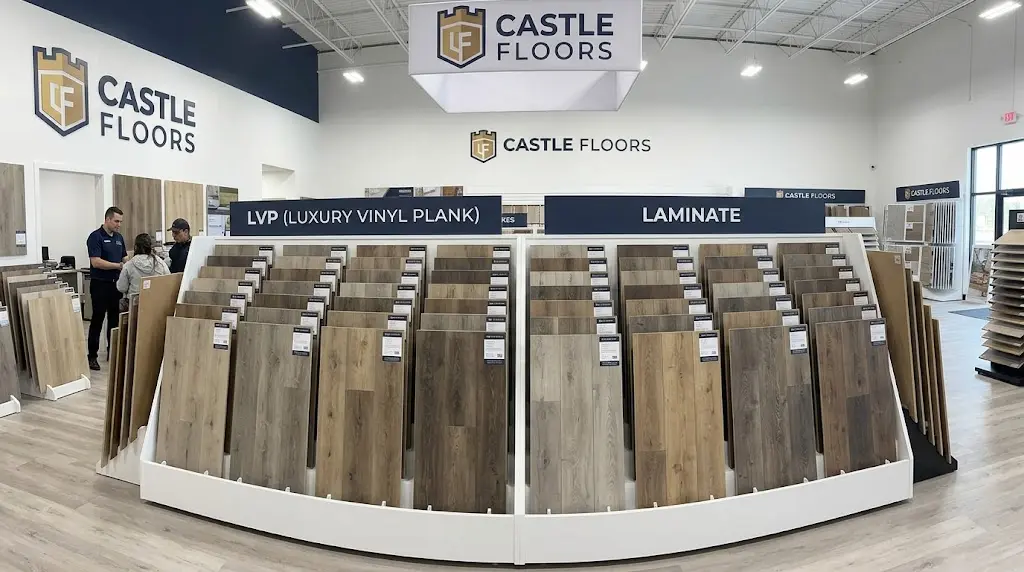
We carry both at our Mesa showroom, and we’ll tell you straight which one is right for your rooms. Stop by at 4500 E Main St., Suite 3, Mesa, AZ 85205, open Monday through Friday 8am to 5pm and Saturday 8am to 4pm. Try our Roomvo flooring visualizer at castlefloorsaz.com/flooring-visualizer to see how both products look in your actual space before you visit. Or book a free in-home estimate at castlefloorsaz.com/free-estimate and we’ll come to you.
Call us at (480) 396-6956.